In today's fast-paced environment, warehouses face constant pressure to improve operations. A key element of achieving this is to "Boost Warehouse Productivity with Efficient Racking Practices." Efficient racking can minimize the time spent locating and accessing products. It maximizes space utilization and can reduce the potential for errors.
Many warehouses use outdated systems that hamper productivity. Products are often cluttered, making it difficult for workers to navigate. This leads to frustration and wasted time. Effective racking systems, however, streamline these processes. They enable quick access to items while keeping everything organized.
Additionally, implementing state-of-the-art racking can be costly and challenging. Warehouse managers should assess their unique needs before investing. Reflecting on past successes and failures provides valuable insights. This journey towards improved productivity is ongoing, requiring consistent evaluation and adjustment. Embracing efficient racking practices will pave the way for a more productive warehouse.
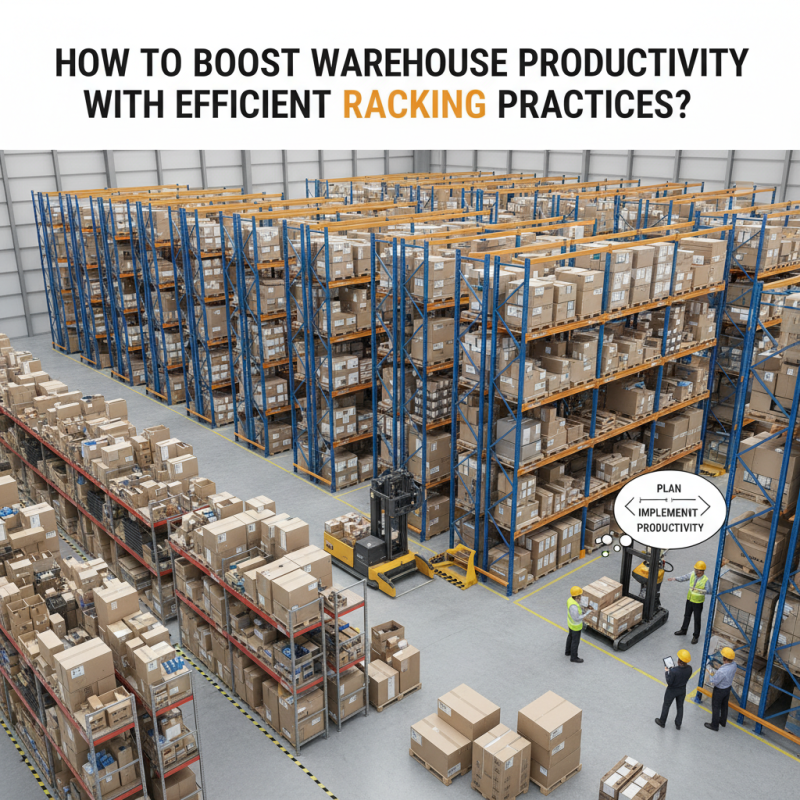
Understanding Warehouse Productivity and Its Importance
Understanding warehouse productivity is crucial for operational success. High productivity leads to quicker order fulfillment and improved customer satisfaction. When employees work efficiently within a well-organized space, they are less likely to encounter frustration. This directly impacts the overall workflow and minimizes errors during picking and packing.
However, many warehouses struggle to achieve optimal productivity levels. Ineffective racking systems can hinder movement and create bottlenecks. For instance, overcrowded aisles can slow down picking times. Additionally, poorly designed racking may lead to misplaced items, creating confusion among staff. It’s essential to ensure that every item has a designated spot. This reduces time spent searching and increases efficiency.
Warehouse management must constantly assess and adapt their space. High shelves can maximize storage but require thoughtful inventory management. Staff should have proper training to navigate the racking system effectively. Regular breaks for employees also play a significant role. Fatigue can lead to mistakes and decreased productivity. Frequent evaluations of workflows can help identify areas needing improvement.
Types of Racking Systems for Optimal Space Utilization
Maximizing space utilization in a warehouse is crucial for improving productivity. One effective strategy is the use of racking systems. Different types of racking can significantly enhance how products are stored and retrieved. For instance, selective pallet racking allows easy access to individual pallets, making it a favored choice. According to the Material Handling Industry (MHI), implementing robust racking solutions can increase storage capacity by up to 30%.
Drive-in racking systems also offer a compact design, allowing for high-density storage. They enable forklifts to access products from one side, optimizing available floor space. This type of racking can lead to increased efficiency in inventory rotation. Research indicates that warehouses using drive-in racks enjoy a 50% improvement in space utilization. However, reliance on this system can create challenges in inventory management, making it necessary to balance efficiency with accessibility needs.
Another popular option is push-back racking. This system allows pallet storage on inclined rails, promoting a first-in, first-out (FIFO) method. Its design permits high-density stacking while maintaining product accessibility. Yet, warehouse operators must occasionally assess its balance with inventory turnover. Industry data shows that when managed correctly, push-back racking can yield up to 25% more space compared to traditional shelving. Choosing the right racking system involves considering specific operational requirements and space constraints.
Best Practices for Organizing Inventory within Racks
Efficient organization of inventory within racks is crucial for enhancing warehouse productivity. According to industry studies, poor organization can cause a 20-30% increase in picking times. High-density storage solutions can mitigate this, ensuring that products are easily accessible. For instance, utilizing vertical space effectively can increase storage efficiency by up to 40%. This practice allows warehouses to accommodate more products without expanding their footprint.
Implementing color-coded labeling systems can simplify inventory identification. Research indicates that teams reduce errors by 25% when labels are clear and visually distinct. However, it's essential to regularly audit this system. Over time, labels may fade, leading to confusion. Keeping the labeling fresh is an ongoing challenge. Equally, mixed inventory can create chaos. Regular reviews can help ensure that items remain in the correct locations.
Another effective method is categorizing inventory based on demand. A recent report showed that warehouses using this practice reduced out-of-stock occurrences by 35%. Nonetheless, this requires constant market analysis to adjust categories effectively. It’s a balancing act. Aligning racking systems with real-time data can seem overwhelming but is vital for maintaining productivity. Each adjustment offers an opportunity for reflection and improvement, driving efficiency in a complex environment.
Implementing Technology for Enhanced Racking Efficiency
Efficient racking practices significantly enhance warehouse productivity. Implementing technology is crucial. According to a recent report by the Warehousing Technology Alliance, adopting automated storage systems can boost efficiency by up to 30%. These systems maximize vertical space and improve access to inventory. Furthermore, real-time tracking technologies, such as RFID, ensure accuracy in stock management.
Integrating warehouse management software (WMS) optimizes storage layouts. A well-designed WMS can reduce picking times by 20% and minimize errors. It enables employees to locate items quickly, leading to smoother operations. Regularly reviewing racking systems and adjusting them based on inventory turnover is essential. Many warehouses find that outdated methods hinder efficiency.
Tip: Invest in training sessions. Employees should understand the technology. Proper training can prevent mistakes and improve morale.
Monitoring and analyzing racking performance is vital. Setting KPIs can help identify areas needing improvement. Some warehouses struggle to implement these strategies effectively. Reflecting on challenges can lead to better solutions and refined practices.
Continuous Improvement Strategies for Racking Practices
Efficient racking practices play a crucial role in enhancing warehouse productivity. Continuous improvement strategies are essential for optimizing these practices. Regularly assess current racking systems. Identify potential inefficiencies. This can lead to better space utilization and faster picking processes. Use tools like RFID technology for accurate inventory tracking. It minimizes errors and speeds up the retrieval process.
Implementing a feedback loop is vital. Encourage warehouse staff to share insights about the racking system. Their firsthand experience can reveal unseen issues. Small changes can lead to significant improvements. For instance, consider the height and accessibility of racking. Overly tall racks can slow down operations. Regular training sessions are essential. Keep employees updated on best practices and safety. A well-informed team is more productive.
However, don’t overlook the importance of adaptability. Racking solutions should evolve with inventory changes and business needs. What works today may not be efficient tomorrow. Conducting periodic reviews can ensure your systems remain relevant. This ongoing dialogue about racking practices fosters a culture of continuous improvement.
FAQS
: Racking systems maximize space utilization and improve productivity.
It allows easy access to individual pallets, enhancing retrieval speed.
Drive-in racking enables compact, high-density storage accessible from one side.
They can complicate inventory management, affecting product accessibility.
It promotes a FIFO method while allowing high-density stacking.
Specific operational requirements and available space are critical considerations.
Automated systems and real-time tracking improve access and accuracy in inventory.
WMS optimizes layouts, reducing picking times by improving item location.
Outdated methods can hinder efficiency, and adjustments based on turnover are essential.
Proper training prevents mistakes and boosts employee morale, influencing overall efficiency.
Conclusion
To boost warehouse productivity with efficient racking practices, it is essential to understand the significance of warehouse productivity and its impact on overall operations. Various racking systems can be employed to maximize space utilization, ensuring that inventory is stored effectively. Best practices for organizing inventory within racks, such as categorization and labeling, can further enhance accessibility and reduce retrieval time.
Incorporating technology, such as inventory management software and automated systems, plays a crucial role in increasing racking efficiency. These tools streamline processes, minimize errors, and provide real-time data on stock levels. Additionally, embracing continuous improvement strategies ensures that racking practices evolve, adapting to changing demands and further driving productivity in warehouse environments. By focusing on these aspects, businesses can significantly enhance their warehouse operations and achieve greater efficiency.

 Asia Racking