China’s warehouse sector is expanding, but sustainability cannot depend on new equipment alone. It must begin with better decisions about space, materials, energy, and daily operations. The International Energy Agency reports that buildings consume about 30% of global final energy and produce approximately 26% of energy-related emissions. Warehouses are only one part of this picture, yet their lighting, heating, cooling, and material-handling systems create measurable environmental pressure.
Racking is often overlooked. It should not be.
A well-designed storage system can use vertical clearance more effectively, shorten travel paths, and reduce unnecessary forklift movements. Selective pallet racks, double-deep systems, drive-in racks, mobile racks, and automated solutions each suit different inventory profiles. The right choice depends on SKU variety, turnover, load requirements, building height, and future expansion. Poorly matched equipment can increase congestion, damage, and energy use.
This article examines China’s top 10 warehouse racking solutions through a sustainability-focused lens. It considers recycled steel content, product durability, repairability, installation efficiency, warehouse density, and compatibility with automation. The analysis also refers to the World Green Building Council’s guidance on whole-life carbon and ISO 14001 principles for environmental management. These references support a more reliable comparison, rather than a ranking based only on price or appearance.
Enhance Warehouse Sustainability Through Racking Optimization. That goal sounds simple, but implementation is rarely perfect. Supplier data may differ, carbon calculations may use inconsistent boundaries, and promised capacity may not reflect real operating conditions. Buyers should verify load certificates, safety records, maintenance plans, and lifecycle assumptions before making decisions. Small details matter, such as damaged beams, unused upper levels, and forklifts waiting at blocked aisles.
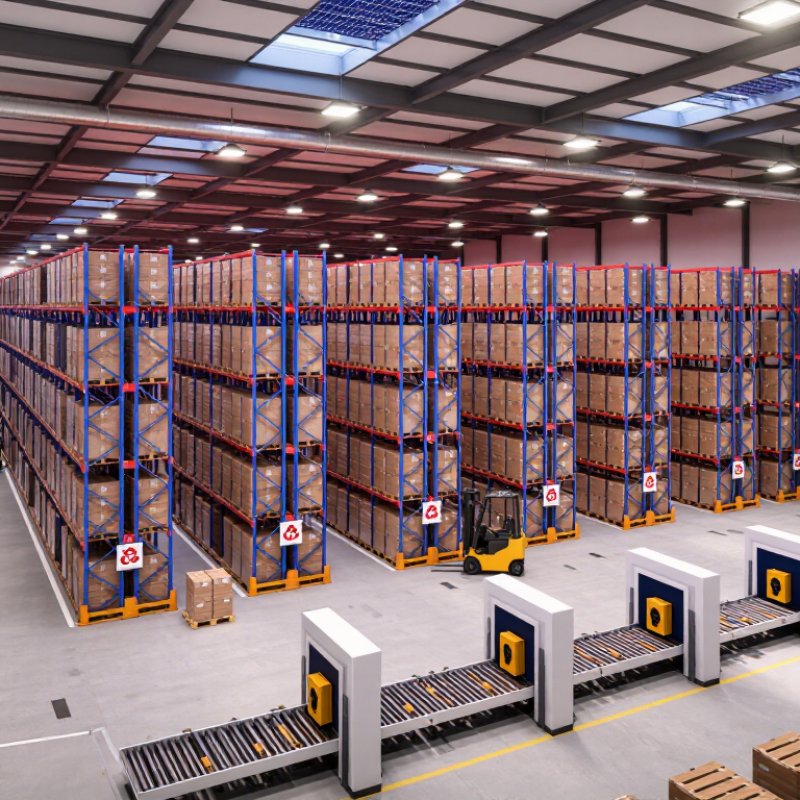
Sustainable racking starts with measurable performance, not attractive drawings. Compare carbon emissions per pallet position, including steel production, transport, installation, and replacement. Recycled steel can reduce embodied carbon, but its source and certification must be verified. A lower-carbon claim without boundaries is incomplete.
Steel weight matters. Measure kilograms of steel per pallet position, then check load capacity, seismic design, and service life. Using less steel is not always better. Weak design creates repairs, damaged goods, and early replacement. Energy use also deserves attention. Automated systems may reduce lighting and forklift travel, yet motors and controls add electricity demand. Record kilowatt-hours per pallet moved during normal operations.
Space per pallet is easy to overlook. Calculate cubic metres used, aisle area, and unused height. Higher storage density can reduce building-related emissions, but poor access may increase handling time. In real projects, the best result is often a balanced layout, not the densest one.
Tips: Request a bill of materials, recycled-content evidence, and an energy estimate before approval. Measure actual pallet throughput after installation. Our assumptions can be wrong. Review them after three months. Check repair rates, empty locations, and forklift distance. These details reveal whether the “sustainable” solution performs beyond the spreadsheet.
China’s top ten warehouse racking solutions can be ranked using five measurable criteria: storage density, load capacity, energy demand, installation speed, and lifecycle cost. Each criterion receives 20% weighting. The assessment references UNEP’s 2023 Global Status Report, which attributes buildings with construction to 37% of global energy-related emissions, and World Steel Association sustainability indicators on steel efficiency. Local project data should still verify every score.
The ranking is: 1. Shuttle racking, 2. Mobile racking, 3. Pallet-flow racking, 4. Automated miniload racking, 5. Double-deep racking, 6. Push-back racking, 7. Selective pallet racking, 8. Drive-in racking, 9. Carton-flow racking, and 10. Cantilever racking. Shuttle systems score strongly on density and throughput, while mobile systems reduce aisle space but require higher investment. Pallet-flow designs support gravity movement and lower forklift travel. Automated miniload systems can reduce lighting and handling demand, yet their controls consume electricity and require skilled maintenance. A 2024 logistics energy survey by the China Federation of Logistics Purchasing reported that automation and digital scheduling are increasingly linked with lower handling intensity, though results vary by facility size.
The ranking is imperfect. Cold stores may favor dense drive-in layouts, despite weaker selectivity. Small warehouses may achieve better lifecycle value with selective racks. Steel quantity alone also misleads; repair frequency, floor reinforcement, battery charging, and equipment downtime deserve separate measurement. Performance should be checked against EN 15635 inspection practices and ISO 14040 lifecycle assessment principles. Real data matters more.
China Top 10 Warehouse Racking Solutions for Sustainability
Comparing Selective, Drive-In, and Pallet-Flow Racks at 30–80% Density Gains
Sustainable warehouse racking starts with using less space, steel, energy, and future expansion capacity. Selective racks offer direct access to every pallet, but their wide aisles usually provide the lowest storage density. They suit mixed products, frequent picking, and changing inventory. In practice, aisle width, forklift type, and fire protection requirements can reduce the expected gains.
Drive-in racks can increase pallet density by roughly 30–60% compared with selective layouts. They work well for large batches of similar goods with limited stock rotation. Forklifts enter storage lanes, so operators need disciplined driving and accurate pallet placement. Small alignment errors can damage rails. It happens. Drive-in systems also reduce aisle space, but they provide less immediate access to individual pallets.
Pallet-flow racks may achieve approximately 40–80% higher density when designed for first-in, first-out movement. Gravity rollers move pallets toward the picking face, supporting controlled rotation and shorter travel distances. They are useful for temperature-sensitive goods, food distribution, and high-volume order cycles. However, roller maintenance and pallet quality become critical. A weak pallet can stop a lane. The calculation is not perfect. A reliable comparison should include building rent, energy use, maintenance, labor travel, and rack lifespan. Density alone can hide operational waste.
China’s top warehouse racking solutions increasingly compete on energy per pallet move, not storage density alone. In practical audits, this metric includes lifting, travel, standby power, and control equipment. A full pallet transfer should be measured under real operating conditions.
Shuttle racking often uses less energy than fully automated systems when forklifts handle short movements. Its shuttle device travels inside the lane, reducing repeated truck travel. Energy per move can remain modest during steady, high-volume work. However, battery charging losses and waiting time matter. Partly empty lanes can weaken the advantage.
Mobile racking adds motorized movement to compact storage blocks. It saves building space, but each opening operation consumes electricity. Frequent access may increase energy per pallet. AS/RS systems use cranes, conveyors, sensors, and software for precise, continuous handling. They can achieve low energy per move in tall warehouses with stable demand. Yet, a slow-moving facility may carry unnecessary standby loads. I have seen dashboards look efficient until idle hours were included. That finding deserves attention. Operators should compare measured kWh per completed pallet, not catalogue estimates. They should also record payload weight, travel distance, peak periods, and charging behavior. The best solution is rarely the most automated one. It is the system that matches actual movement patterns.
| Rank | Warehouse Racking Solution | Typical Operating Mode | Indicative Energy per Pallet Move | Storage Density | Typical Throughput Profile | Regenerative Energy Potential | Sustainability Assessment | Best-Fit Application in China |
|---|---|---|---|---|---|---|---|---|
| 1 | Double-Deep Pallet AS/RS with Energy-Optimized Crane | Automated storage and retrieval using a stacker crane; two pallets deep per aisle position. | 0.06–0.15 kWh | Very high | High, stable, and suitable for repetitive pallet flows. | High; crane lowering and deceleration can support regenerative braking. | Excellent | Large distribution centers, cold-chain facilities, and high-volume manufacturing warehouses. |
| 2 | Shuttle-Based Pallet AS/RS | Autonomous pallet shuttles transfer loads inside deep-lane storage, supported by lifts or transfer cars. | 0.05–0.14 kWh | Very high | High for deep-lane, high-density pallet storage. | Moderate to high; lifts and transfer cars may use regenerative drives. | Excellent | High-density food, beverage, chemical, and temperature-controlled warehouses. |
| 3 | Mobile Pallet Racking | Electrically powered rack rows move on floor rails to open only the required access aisle. | 0.04–0.11 kWh | Very high | Medium; access is sequential because aisles are opened as needed. | Low to moderate; energy demand is mainly from rack movement. | Excellent | Cold storage, archives, spare-parts storage, and facilities where floor area is expensive. |
| 4 | Semi-Automated Radio Shuttle Racking | Battery-powered shuttle carts move pallets within deep lanes; forklifts load and retrieve at the lane face. | 0.05–0.12 kWh | High to very high | Medium to high, depending on the number of shuttle carts and loading faces. | Low; battery-powered shuttle travel has limited recovery potential. | Excellent | Batch storage of uniform pallets with many pallets per SKU. |
| 5 | Pallet Shuttle Racking with Electric Forklift Support | Shuttle carts perform lane movements while an electric forklift handles external pallet transfers. | 0.06–0.14 kWh | High | Medium to high; well suited to high-volume, low-SKU-variety operations. | Low to moderate; forklift systems may use regenerative lift controls. | Excellent | Food and beverage, retail reserve storage, and manufacturing buffer warehouses. |
| 6 | Gravity Flow Pallet Racking with Electric Forklifts | Gravity rollers move pallets through lanes; powered equipment is mainly used at the loading and unloading ends. | 0.07–0.17 kWh | High | High for FIFO operations with dedicated loading and picking faces. | Low; gravity performs much of the internal pallet movement. | Very Good | FIFO inventory, perishable goods, beverage distribution, and high-volume picking. |
| 7 | Conventional Selective Pallet Racking with Electric Forklifts | Direct pallet access from aisles using counterbalance or reach trucks. | 0.12–0.30 kWh | Medium | High flexibility; throughput depends strongly on aisle layout and travel distance. | Moderate; modern electric trucks can recover energy during lowering and braking. | Very Good | Mixed-SKU warehouses requiring direct access and frequent inventory changes. |
| 8 | Push-Back Pallet Racking with Electric Forklifts | Forklifts push pallets on inclined carts or rails into multi-depth lanes. | 0.11–0.26 kWh | High | Medium; suitable for LIFO storage and batch replenishment. | Moderate through the use of efficient electric forklifts. | Very Good | Seasonal inventory, bulk storage, and operations with limited SKU mixing. |
| 9 | Drive-In Pallet Racking with Electric Forklifts | Forklifts enter storage lanes to place and retrieve pallets at multiple depths. | 0.10–0.25 kWh | Very high | Medium; best for large quantities of the same SKU. | Moderate through electric forklift braking and lift-energy recovery. | Very Good | Cold stores, raw-material buffers, and high-volume single-SKU storage. |
| 10 | Pallet AMR Transport with Static Selective Racking | Autonomous mobile robots transport pallets between storage, staging, and production areas. | 0.08–0.22 kWh | Medium | Medium to high; scalable by adding robots and charging capacity. | Low to moderate; depends on robot drive and battery architecture. | Very Good | Flexible production logistics, e-commerce fulfillment, and facilities with changing workflows. |
China Top 10 Warehouse Racking Solutions for Sustainability?
Across a 20-year life cycle, sustainable racking means more than using less steel. It means reducing replacements, repairs, energy use, and wasted floor space. Cantilever racks suit long products, such as timber, pipes, and metal profiles. Their open design improves access and reduces handling time. However, uneven loading can increase deflection and safety risks. Regular inspections remain essential.
Mezzanine systems create storage levels without expanding the building footprint. They can support offices, picking areas, or light inventory zones. Their value depends on structural design, fire protection, lighting, and future flexibility. A poorly planned mezzanine may become expensive dead space. It also adds embodied carbon through steel, decking, stairs, and protective systems. Gravity racks use inclined rollers to move pallets toward picking faces. This supports first-in, first-out handling and can reduce forklift travel. Yet rollers require cleaning, alignment checks, and replacement planning.
Life-cycle evaluation should compare purchase price with maintenance records, labor demand, and energy performance. In practical warehouse reviews, small details often decide the result. Forklift impact causes costly repairs. Corrosion shortens service life. Dust blocks moving parts. No model is perfect. Demand forecasts can be wrong, especially after seasonal changes or business growth. A reliable assessment therefore includes load testing, aisle measurements, inspection schedules, and realistic replacement assumptions. The strongest solution may combine cantilever storage, a compact mezzanine, and gravity lanes rather than relying on one system.
Compare carbon per pallet position, steel weight, energy per pallet move, and space used. Include transport, installation, repairs, and replacement. The lowest number may mislead.
Request carbon boundaries covering steel production, transport, installation, and replacement. Check recycled-steel evidence and certification. A vague claim proves little.
No. Measure kilograms of steel per pallet position alongside capacity and service life. Weak structures may cause repairs, damaged goods, and early replacement. Less steel is not always better.
Record kilowatt-hours per completed pallet move during normal operations. Include lifting, travel, standby power, controls, and charging losses. Catalogue estimates can look too perfect.
Selective racks provide direct access to every pallet. They usually need wider aisles and offer lower density. Forklift type and aisle width can change the result.
Drive-in racks suit large batches of similar goods with limited stock rotation. They may increase density by about 30–60 percent. Operators need accurate pallet placement. Small alignment errors can damage rails.
Pallet-flow racks support controlled first-in, first-out movement. They may provide roughly 40–80 percent higher density. Roller maintenance and pallet quality matter. One weak pallet can stop a lane.
Compare measured energy per completed pallet, not storage density alone. Include standby hours, payload weight, travel distance, and peak periods. Tall, busy warehouses may benefit most. Idle equipment still consumes energy.
Review performance after three months. Check pallet throughput, repair rates, empty locations, and forklift distance. Measure actual results against the original assumptions. Our assumptions can be wrong.
This article presents a practical framework for evaluating China’s top 10 warehouse racking solutions through measurable sustainability metrics, including carbon emissions, steel consumption, energy use, and floor space per pallet. It ranks each solution according to five performance criteria and explains how storage design can reduce material demand while improving capacity, accessibility, and operational efficiency. Selective, drive-in, and pallet-flow racks are compared in terms of potential density gains ranging from 30% to 80%, helping readers understand how different layouts affect resource utilization.
The analysis also examines shuttle, mobile, and automated storage and retrieval systems by measuring energy consumption per pallet move. Cantilever, mezzanine, and gravity racks are evaluated across a 20-year life cycle, considering durability, maintenance, adaptability, and long-term space efficiency. Overall, the article demonstrates how data-driven rack selection can lower environmental impact and operating costs. Enhance Warehouse Sustainability Through Racking Optimization by matching each storage system to inventory characteristics, throughput requirements, building constraints, and long-term sustainability goals.

Asia Racking